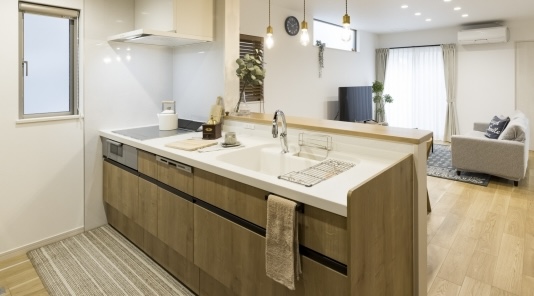
What does an ordinary Japanese home kitchen actually look like? Mine is just a normal kitchen in the apartment my husband and I rent, and most days I don’t think about it much at all. But when I stopped to actually look at how we use it, from the layout to the appliances, I realized it says a lot about how space works in an ordinary Japanese home — not because anything about it is extreme, but because almost nothing about it is.
What My Japanese Home Kitchen Looks Like
My kitchen is a single-wall setup — everything (sink, stovetop, counter) lines up against one wall, rather than facing out into the room. To me, it feels like a normal size. I know some one-person apartments in Japan have kitchens much smaller than mine, so I don’t think of mine as cramped.
There’s enough counter space to set a cutting board down and actually work, which matters more than it sounds like it should. The stovetop has two burners, and combined with the counter and sink, that’s the whole kitchen — simple, but enough for how I actually cook. Storage is decent too — I’m not short on places to put things away. None of this is dramatic. It’s just functional.
Making Room for Kitchen Appliances
The kitchen itself can’t hold everything we own, so some things have ended up living outside it.
The Microwave on Top of the Refrigerator
My microwave sits on top of the refrigerator. There wasn’t a natural spot for it on the counter, and the top of the fridge was just sitting there empty, so that’s where it went. It’s not a design choice so much as a practical one — the refrigerator is tall enough, and it’s close enough to where I cook.
When the Kitchen Isn’t Big Enough for Everything
The rice cooker and the toaster don’t live in the kitchen at all. There simply isn’t room for them on the counter alongside everything else, so we keep a larger cabinet in the living room, and that’s where both of them sit, along with some dishware and pantry items like canned food that don’t need refrigeration. It’s less a “rice cooker shelf” and more the kitchen’s overflow storage, just located one room over. It sounds like it might be inconvenient, but the living room is right next to the kitchen, so in practice it barely changes how I cook. A rice cooker like this is something many Japanese households use on a daily basis, which is probably part of why ours has earned a permanent spot even outside the kitchen — if you’re curious just how central rice is to a day like this, I’ve written more about how rice fits into everyday life in Japan.
How I Actually Use My Kitchen Every Day
Some of the dishes I make regularly are stir-fried dishes, simmered dishes, fish, and soup. Nikujaga — a simmered dish of meat and potatoes — and simmered daikon come up often, and I make miso soup or other soups pretty regularly too. Nothing unusual, just what ends up on the table on a normal weeknight.
For fish, I usually use the oven function on my microwave rather than a stovetop grill. A built-in oven isn’t something you commonly see in the kind of apartment kitchen I’m used to, so a combination microwave — one that microwaves, grills, and bakes — is what fills that role instead. Mine is one of those, and using its oven function to cook fish is just a normal part of how I cook, not a special technique.
The Kitchen Tool I Use Almost Every Day
If I had to name one tool I reach for almost every time I cook, it’s a MUJI silicone cooking spoon. It’s a simple thing — a long-handled spoon with a heat-resistant silicone head — but I use it constantly.
I used to switch between cooking chopsticks and a wooden spatula depending on what I was making. Now this one spoon covers most of that job by itself. I use it to stir-fry vegetables, to stir a pot of soup, and then to transfer food straight from the pot onto a plate — sometimes all in the same meal. It’s flexible enough to follow the curve of a pan, sturdy enough to stir something simmering, and steady enough to serve with afterward. It’s less that I found a single “better” tool and more that one tool quietly started doing the job of two or three — which also means one less thing to find a spot for, in a kitchen where cabinet space isn’t something I have to spare.
Keeping the Kitchen Clear
I try not to let things pile up on the counter. Part of it is just personal preference — I like a clear counter — but part of it is practical too: oil splatters when I’m stir-frying, so I use a splatter guard over the pan, and anything left sitting out on the counter still tends to get greasy. Once I’m done with something, I deal with it right away rather than leaving it out “for convenience”: seasonings go straight back to where they belong, and pots, the cutting board, and other cooking tools get washed, dried, and put away. It takes a few extra minutes each time, but the counter basically resets to empty after every meal.
My Parents’ Kitchen Was Different
My parents’ kitchen faces out into the living and dining area, rather than sitting against a wall, and it’s bigger than mine — more counter space, more storage, and three stovetop burners instead of my two. That extra burner matters more than it sounds like it should: with three burners, my parents could have a simmered dish, a stir-fry, and a pot of soup all going at the same time. I can usually get two things going on my two burners without a problem, but there’s less room to add a third without waiting for one of them to free up. Comparing the two, I’ll be honest: I think their kitchen was better to cook in. It’s not that my current kitchen doesn’t work — it’s just that theirs gave you more room, and more heat sources, to work with, and that’s a difference I noticed clearly whenever I cooked there.
What Feels Normal to Me as a Japanese Person?
A few things in my kitchen feel so ordinary to me that I never really think about them: cooking chopsticks, a shamoji for serving rice, kitchen scissors, and the combination microwave-oven I already mentioned. None of these are exclusive to Japan — rice paddles and kitchen shears exist elsewhere too — but they’re such a fixed part of daily cooking here that I’d genuinely be a little stuck without them.
The Everyday Version of a Japanese Kitchen
None of this adds up to some perfectly designed system. It’s a kitchen where the fridge holds the microwave, the living room doubles as extra storage for the rice cooker, the toaster, and a few dishes and pantry items, and one spoon does more jobs than it probably should. The kitchen itself isn’t especially big, but there’s enough counter space to actually cook, enough storage that I’m not short on places to put things away, and two stovetop burners that cover what I need on a normal day. I wash and put things away as I go, so the counter usually stays clear. Compared to my parents’ kitchen, with its three burners and extra room to work with, mine does have its limits — but for me, the kitchen isn’t something I consciously think about anymore. I just know where everything goes and how to make the space work — and most days, that’s the whole story.