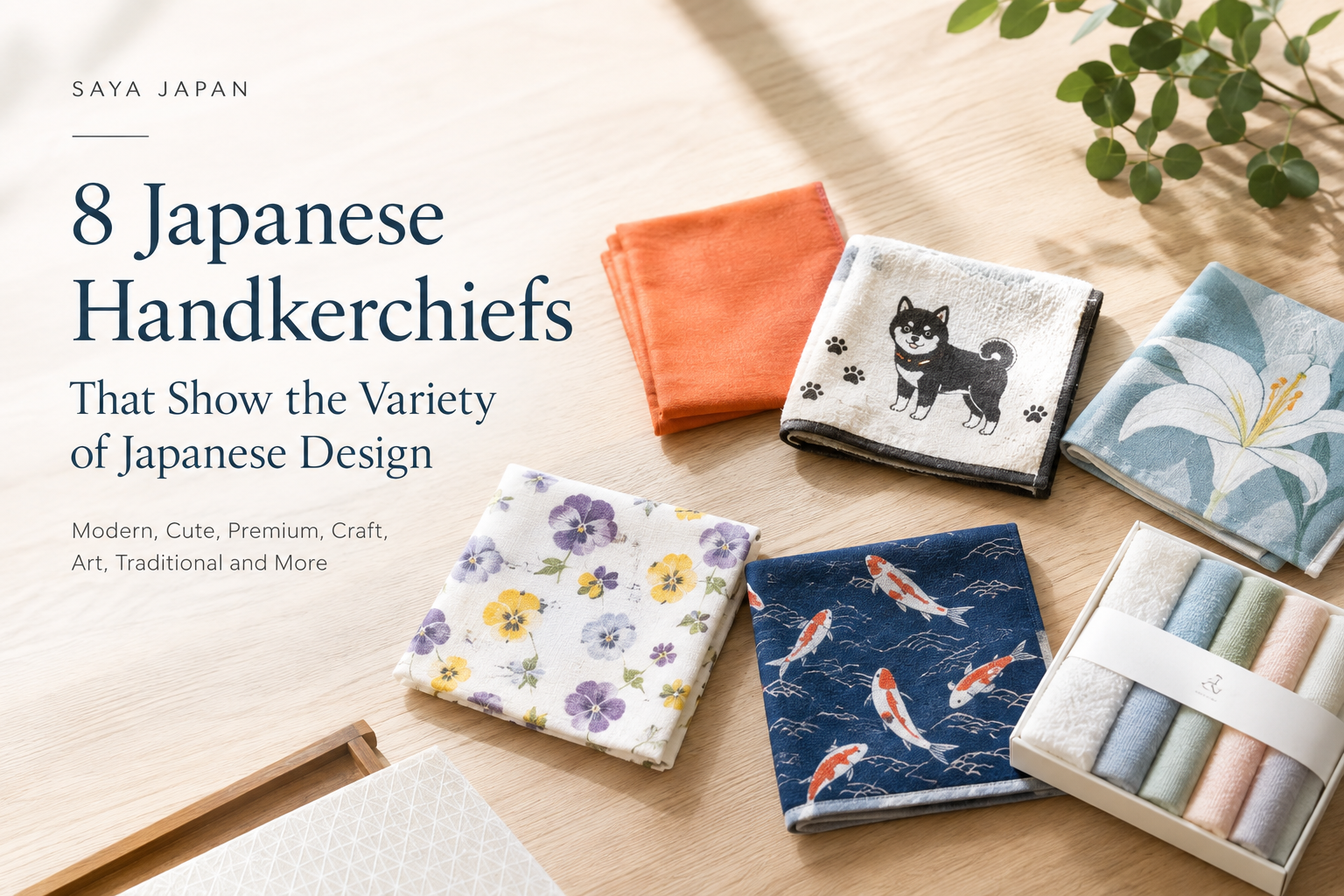
A handkerchief is one of the most ordinary things you can buy in Japan. It goes into a bag or a back pocket, gets used to dry hands after a public restroom, and rarely gets a second thought once it’s there — why handkerchiefs are such a normal thing to carry in Japan is a story on its own. But look at what different brands are actually doing with that same small square of fabric, and the differences add up fast. Some keep things simple and modern. Others lean into cute characters, hand-dyeing techniques passed down for generations, or printing methods that only reveal their pattern when held up to light.
This list brings together eight handkerchiefs from eight different brands, each one chosen to represent a different side of Japanese design: cute, premium, everyday, craft, contemporary textile art, traditional, regional, and something closer to an experiment in what a handkerchief can be. None of them is presented here as “the best.” The point is to show the range, from a plain, everyday cotton towel to a piece of fabric that changes depending on how the light hits it. Most of the products below can be purchased from outside Japan, either through Amazon or the brands’ own online shops.
8 Japanese Handkerchiefs to Discover
HAMAMONYO — Cute & Fun
Gauze Pile Handkerchief – Shiba-Kun
HAMAMONYO goes in a different direction with its Shiba-Kun handkerchief, printed with a black Shiba Inu design. It’s made from a gauze-and-pile cotton weave — a soft, slightly textured double-layer fabric that shows up often in Japanese baby and household goods. It isn’t trying to be premium or sophisticated. It’s a casual, inexpensive item that leans fully into being cute, which is its own legitimate corner of Japanese product design. For a gift aimed at someone who likes dogs, or who just wants something playful rather than refined, it’s a different kind of “Japanese handkerchief” than most people picture.
View the product at Gauze Pile Handkerchief – Shiba-Kun (paid link)
CLASSICS the Small Luxury — Premium & Giftable
Even a Dog Will Eventually Stumble Upon a Stick
This one sits at a different end of the price and craft spectrum. Made from a 50% cotton, 50% linen blend and measuring 41 x 41 cm, it’s built around a Japanese proverb — inu mo arukeba bou ni ataru, roughly “even a dog that walks around will eventually run into a stick.” It’s generally read as a reminder that going out and doing something, rather than staying still, tends to lead somewhere. On the handkerchief, a dog tugging at the fabric and a stick are embroidered in detail, while the surrounding grass is rendered in fringe. CLASSICS also offers optional embroidered initials and gift box or envelope packaging, which fits its positioning as a small luxury item rather than an everyday one. It’s a good example of a Japanese product that uses language and meaning as the design itself, not just decoration.
View the product at Even a Dog Will Eventually Stumble Upon a Stick
imaa — Everyday Imabari
Japanese Imabari Towel Set
Not every Japanese handkerchief needs to be decorative. imaa’s towel set makes the case for the other side of the category: six mini towels, each about 25 x 25 cm (9.8 x 9.8 in), made from 100% cotton in Imabari, a region on Japan’s western coast known for towel manufacturing. They’re vacuum-packed and sold as a set rather than individually, which is a very different buying experience from the single, curated handkerchiefs elsewhere on this list. There’s no motif, no proverb, no artist collaboration — just a well-made, absorbent cotton towel, multiplied by six. For anyone who wants something they’ll actually use daily rather than display, this is closer to what a lot of people in Japan keep in a drawer.
View the product at Japanese Imabari Towel Set (paid link)
KASHIKO JAPAN — Japanese Craft
Hankachi 〈White Lily〉
KASHIKO JAPAN’s White Lily handkerchief is where hand craftsmanship becomes the main story. It’s 100% cotton, hand-dyed using a traditional method called oka sarashi at the Baba Dyeing Studio in Kyoto, a workshop with more than 110 years of history. The design — a single white lily — comes from Satomi Kawada, an artist known for Kutani-yaki ceramics, and the finished piece measures 360 x 340 mm. What sets this apart from the more contemporary otsukiyumi piece later on this list is the emphasis on an established dyeing technique and a named workshop, rather than a new pattern design. It’s a handkerchief built around a specific, traceable process, not an aesthetic alone.
View the product at Hankachi 〈White Lily〉
otsukiyumi — Contemporary Textile Art
Handkerchief Pansy
otsukiyumi’s Pansy handkerchief takes a more artistic route. It’s 100% cotton, woven in a lightweight plain-weave fabric, and measures about 52 x 52 cm — noticeably larger than most of the other handkerchiefs here, closer to a small scarf than a pocket square. The pattern shows several pansies in different colors and forms, based on flowers observed in a garden, and because of how the fabric is cut, the exact placement of the pattern shifts slightly from one piece to the next. Where KASHIKO JAPAN represents an established hand-dyeing technique, otsukiyumi works more in the direction of original textile pattern design. Given the larger size, it can double as a light scarf or small wrap rather than something folded into a pocket, and the brand’s own shipping page lists international ePacket rates for overseas orders.
View the product at Handkerchief Pansy
EIRAKUYA — Traditional Kyoto
Tehan “Five Leaping Carp” (下)
EIRAKUYA calls this type of cloth a “tehan” — its own name for a tenugui-style cotton cloth cut down to handkerchief size, with the same traditional Japanese feel as a full tenugui but more pocket-sized. This piece is printed with a design of five carp in motion (五鯉躍), made from 100% cotton in a finer weave, and finished at around 36 x 36 cm. According to EIRAKUYA’s own product page, it’s sold as an online-shop-exclusive, limited-production item. EIRAKUYA itself is a long-established textile company based in Kyoto, which is part of what makes this piece read as the most traditional pick on this list: a classic motif from a brand with real roots in Kyoto’s textile trade, rather than a modern reinterpretation of one.
View the product at Tehan “Five Leaping Carp” (下)
YURI HIMURO / swimmie — A Handkerchief That Changes with Light
Transparent Printing Handkerchief | Forest
The last handkerchief on this list works differently from the other six. Made from 100% cotton and measuring 50 x 50 cm, it uses a technique called transparent printing, where the forest pattern isn’t fully visible against a plain background — it only becomes clear when the fabric is held up to a light source. swimmie describes the design as evoking a dark forest, one where you can’t see far around you but can sense something moving nearby. Product photos are backlit to show the printed pattern; laid flat under normal light, the handkerchief looks much plainer. It’s not the kind of item most people would reach for daily, and it isn’t trying to be. It’s included here as a reminder of how far a plain, everyday textile can be pushed once a brand starts treating it as a material for experimentation, not just a functional object.
View the product at Transparent Printing Handkerchief | Forest
Fukuroya Towel / SHIZUKU — Senshu Towel Craft
SHIZUKU Towel Handkerchief — Mizunasu (Water Eggplant) Dye
The eighth handkerchief on this list isn’t built around a named artist or a proverb — it’s built around a place. Fukuroya Towel is a long-established towel maker in Izumisano, part of Osaka’s Senshu region, an area generally credited as the birthplace of Japan’s domestic towel industry, dating back to 1887. Its SHIZUKU line dyes plain cotton with color extracted from vegetables grown nearby — water eggplant, onion, carrot, cabbage, basil — instead of synthetic dye, and skips bleach and optical brighteners so the color comes only from the vegetable itself. The mizunasu (water eggplant) version gets its soft purple from the skin of an Osaka eggplant variety that’s mild enough to eat raw. Because the dye comes from produce rather than a fixed formula, no two batches look quite identical, and the company treats that as part of the product rather than something to correct. It’s a quieter kind of “Japanese handkerchief” than most of the others here — less about design, more about a towel town using what already grows around it.
View the product at SHIZUKU Towel Handkerchief — Mizunasu (Water Eggplant) Dye
| Brand | Style | Material | Best for | Where to Buy |
|---|---|---|---|---|
| HAMAMONYO | Cute | Gauze pile cotton | A playful, casual gift | Amazon |
| CLASSICS the Small Luxury | Premium | 50% cotton / 50% linen | A special gift | Official shop |
| imaa | Everyday | 100% cotton | Daily, practical use | Amazon |
| KASHIKO JAPAN | Craft | 100% cotton | Craftsmanship-focused gifts | Official shop |
| otsukiyumi | Contemporary textile art | 100% cotton | Art and textile design lovers | Official shop |
| EIRAKUYA | Traditional | 100% cotton | A traditional Kyoto feel | Official shop |
| YURI HIMURO / swimmie | Innovative | 100% cotton | Art and textile design lovers | Official US shop |
| Fukuroya Towel / SHIZUKU | Regional craft | 100% cotton | A regional, story-driven pick | Official retailer |
Why Japanese Handkerchiefs Make Good Gifts
Part of the appeal is simply practical: a handkerchief is small, light, and a practical gift that doesn’t take up much space in a suitcase, which makes it one of the more realistic things to actually carry home from a trip to Japan rather than just admire in a shop. The range of designs and price points also means there’s usually something that fits a given budget, whether that’s a few dollars for a printed cotton square or considerably more for a hand-dyed or embroidered piece. Beyond that, a number of Japanese handkerchiefs carry a specific design idea, craft technique, or regional connection behind them, which gives a gift a bit more to talk about than a generic souvenir would. None of this means every recipient will love a handkerchief as a gift — that depends entirely on the person — but as a category, it’s an easy one to justify.
Final Thoughts
A handkerchief is a small, everyday item, but these eight examples show how differently Japanese brands can approach the same basic object. There’s the playful design of HAMAMONYO, the embroidered proverb of CLASSICS the Small Luxury, the practical multipack from imaa, the hand-dyeing craft of KASHIKO JAPAN, the original textile art of otsukiyumi, the traditional Kyoto motif from EIRAKUYA, the light-dependent design from YURI HIMURO / swimmie, and the vegetable-dyed towels from Fukuroya Towel’s SHIZUKU line. None of them needs to be the “right” choice — they’re simply eight different starting points, depending on what you’re actually looking for. If one of them fits, the product pages linked above are a reasonable place to take a closer look.