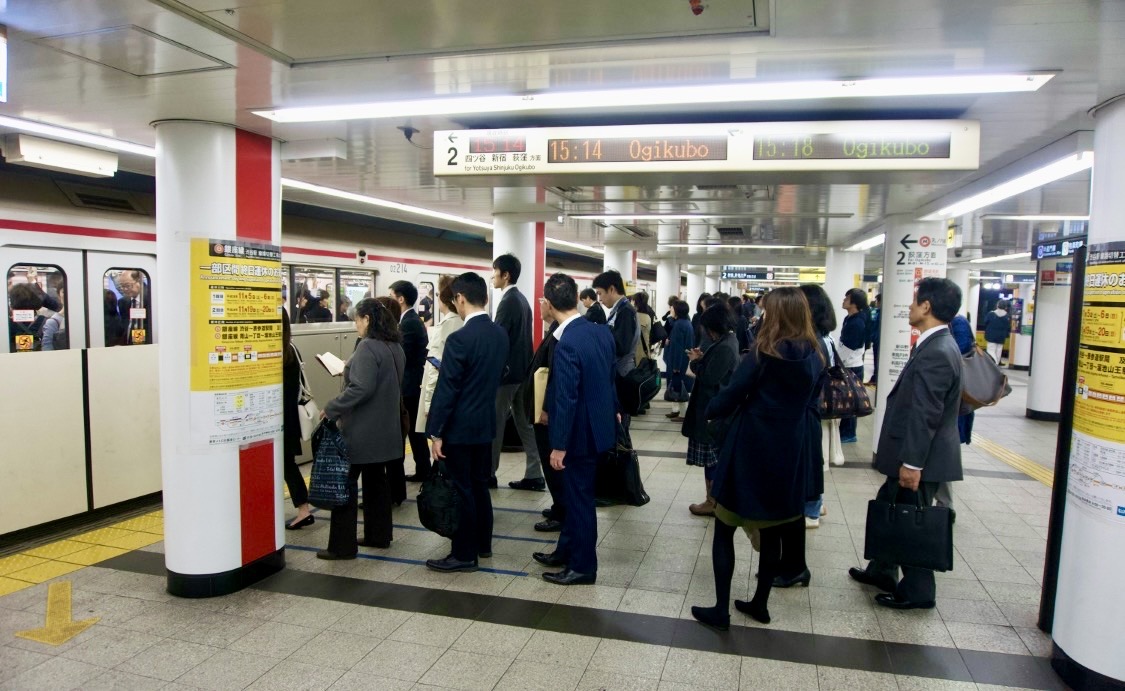
On a Tokyo platform, people stand in tidy lines marked out by floor tape, waiting their turn to board. A few seconds later, the doors open, and the same orderly line dissolves into one of the most crowded spaces you’ll ever stand in.
Nobody seems to find this strange.
That contrast — careful order on the platform, total crush inside the train — is a good place to start thinking about what Japanese queue culture actually is, and what it isn’t.
It’s tempting to explain it with one word: politeness. But that’s too easy, and it’s not really accurate.
Queuing in Japan isn’t a special national talent for patience, and it’s not proof that everyone here loves following rules. It’s closer to something simpler: waiting in line is just what people are used to doing, and Japan has built a lot of systems that make that waiting easier to manage — including systems designed so you don’t have to physically stand in a line at all.
Why Do Japanese People Queue So Much?
There isn’t one single reason.
A queue gives everyone a clear, visible sense of who was there first, which feels fair without anyone needing to enforce it. It’s also a way of not creating a hassle for the people around you — cutting in, or standing somewhere unclear, tends to slow everyone else down or create confusion, and most people would rather avoid that.
Stations, shops, and event venues also do a lot of the work themselves, with floor markings, signage, and staff who point you toward where to stand.
And on top of all of that, queuing is just familiar.
Most people grow up doing it constantly — at school, at the bus stop, at the register — so by adulthood it’s closer to a reflex than a decision.
None of these reasons work well as a single explanation on their own.
Fairness matters, but so does the physical layout of the space. Habit matters, but so does not wanting to be the person who throws off the line.
It’s a combination, not a formula.
Queuing Is Often Just “Normal” in Japan
Many people don’t think much about it
For a lot of people, standing in line isn’t really a decision at all — it’s just what happens automatically when there’s a line to join.
I’ve always felt that way about it myself. I can’t point to a moment when I decided that queuing was the right thing to do. It’s just always been an ordinary part of getting through the day, the same way you’d wait for a traffic light.
But waiting in line isn’t necessarily enjoyable
Normal doesn’t mean enjoyable, though.
When I’m standing in a line at a station or a shop, what’s actually going through my head is usually something like:
Is this still going to take long? I wish it would move faster.
That’s a pretty ordinary reaction, and I don’t think it’s unusual — accepting a queue as the normal way things work is not the same as liking the wait itself.
Why Queuing Works So Well in Japan
First-come, first-served feels fair
A visible line does something useful: it makes the order of service obvious without anyone needing to argue about it.
If you can see who arrived before you, there’s nothing to negotiate.
People learn the system through everyday life
Queuing gets reinforced constantly, in places that have nothing to do with each other — waiting for a bus, lining up at a school event, standing at a shop counter, filing onto a platform.
None of these situations are formally “teaching” anyone to queue.
It’s just repetition, over years, in enough different settings that it stops feeling like a rule and starts feeling like the default.
The environment makes queuing easier
A lot of what looks like disciplined behavior is actually good system design.
Floor markings show you exactly where to stand. Signs tell you which line is for what. Staff redirect people before confusion builds up.
Digital call-up systems and numbered tickets remove the need to stand anywhere at all.
None of this happens by accident — it’s infrastructure doing a lot of the quiet work that culture usually gets credit for.
This is also one reason why seemingly small public rules can feel different from place to place. For example, Japan’s escalator etiquette can vary depending on the region and is changing over time.
Japanese People Don’t Always Want to Stand in Line
This is really the heart of it.
Japan has built a lot of ways to wait for your turn without physically standing in a line — and a lot of people prefer those.
Tickets, numbers, and reservations can replace a physical line
Numbered tickets at a bakery or a government office, meal tickets at some restaurants, call-up systems at clinics, reservations and time slots for popular attractions, digital queue apps that let you wander off and come back when it’s your turn — all of these exist specifically so nobody has to stand around.
Waiting without standing can be more convenient
I’ve used numbered tickets and restaurant meal-ticket systems myself, and honestly, I find them a lot more convenient than physically standing in a line.
If I’m being completely honest, my opinion is basically: it would be great if everything worked this way.
Being able to grab a number, sit down, or step away for a few minutes, instead of holding a spot with your body — that’s just a better use of everyone’s time.
Why Do People Still Line Up at Popular Restaurants?
A long line can make a restaurant look worth trying
There’s an odd psychological flip that happens with restaurant queues specifically.
When I see a place with a really long line outside, my first thought is often:
It must be good — I want to try that.
A queue works almost like a signal: enough people are willing to wait, so maybe there’s something to it.
This isn’t unique to Japan by any means, but it’s a real part of why some restaurants keep long lines even when the food inside probably doesn’t need the extra hype.
But people don’t necessarily wait forever
That curiosity has limits, though.
If the wait looks excessive, I’ll usually just decide it’s not worth it and walk away.
Wanting to try somewhere popular and being willing to stand outside for two hours are two completely different things — and for most people, only one of those is actually true most of the time.
The Surprising Side of Japanese Queue Culture
Orderly boarding lines — then an extremely packed train
Here’s where the tidy-platform image gets complicated.
The same commuters who lined up so carefully to board can end up squeezed into a train car so tightly they can barely move a few seconds later — this is the level of crowding that oshiya, station staff sometimes associated with physically pushing passengers into packed trains, became known for.
That’s really all this detail needs to do here: it’s not a history lesson, just a vivid reminder of how far “orderly” can stretch before it starts looking like something else entirely.
That contrast is really the point.
People wait in careful, orderly lines — and then step straight into one of the most physically crowded experiences you can have in daily life.
Neither part cancels the other out.
If anything, it’s proof that “Japanese people are naturally orderly” doesn’t hold up as a full explanation.
Order and crush exist side by side here, and the queue culture people notice on the platform is only half the picture.
If you’re interested in the other side of Japanese train culture, you can also read Why Are Japanese Trains So Quiet?.
My own strategy for crowded trains
I don’t always queue neatly to board, honestly — if there aren’t that many people around, I don’t see much point.
But when I know I need to get off quickly at my stop, I do think ahead about it.
I’ll sometimes position myself toward the back of the boarding line on purpose, aiming to end up near the door, so that when the train arrives at my stop, getting off is easier.
It’s less about following a rule and more about a small, practical trick for a system that can get genuinely overwhelming.
What Happens If Someone Cuts in Line?
Queue-cutting is generally considered rude
Taking your place in line and waiting your turn is a pretty basic social expectation — breaking it, even accidentally, tends to draw attention.
People don’t always stay silent about it
But that doesn’t mean everyone just lets it slide.
I’ve had someone cut in front of me before, and I told them directly:
“We’re already waiting in line,”
and asked them to go to the back.
Social norms like this don’t maintain themselves — people actually speak up when they’re crossed, even if it happens quietly and without much drama.
Do Japanese People Always Queue?
A few common assumptions are worth pushing back on directly:
- “Japanese people always queue.” Not really — it depends heavily on the crowd size, the location, and whether there’s even a clear line to join.
- “Japanese people enjoy waiting.” Enjoying it and accepting it as normal are two different things, and most people would probably tell you it’s the second one.
- “Nobody ever cuts in line.” People do, occasionally — and other people notice, and sometimes say something.
- “Japan’s queue culture is perfect, and everyone follows exactly the same rules.” Behavior shifts by region, by venue, by how busy a place is, and by the individual. A packed festival, a quiet neighborhood bakery, and a rush-hour platform can all produce pretty different queuing behavior, even within the same city.
Queue Etiquette for Travelers in Japan
A few practical things that help:
- Look for signs and floor markings. Many stations and shops mark exactly where a line starts, which side to stand on, and where it ends.
- Check whether you need a ticket or reservation first. Some restaurants and offices use a numbered-ticket or call-up system instead of a physical line — walking up and standing behind the last visible person isn’t always the right move.
- Let people get off the train before boarding. This is especially important on busy trains. Tokyo Metro, for example, advises passengers to wait behind the yellow warning blocks and let alighting passengers get off before boarding. You can check its official guidance for boarding the subway.
- Don’t assume an empty-looking space is the end of the line. Lines sometimes wrap around corners or split by direction. If it’s not obvious, it’s fine to ask.
- If you’re unsure, just ask. A simple line works well almost anywhere: “Excuse me, is this the line for ___?”
So, Why Do Japanese People Queue So Much?
Not because Japanese people are especially polite, and not because standing in line is something anyone particularly enjoys.
Queuing works here because it’s familiar, visibly fair, and supported by quiet infrastructure — floor markings, numbered tickets, call-up systems, and other ways of making waiting easier to manage, with or without an actual line involved.
Japanese people don’t necessarily love waiting.
They’ve just had a lot of practice doing it in an organized way — and, where possible, plenty of practice avoiding it altogether.
Recommended External Sources
For readers who want to understand train etiquette directly from railway operators:
- Tokyo Metro — Before Getting on the Subway — official guidance on waiting and boarding.
- JR East — Train and Platform Manners — official guidance on boarding, alighting, and passenger manners.