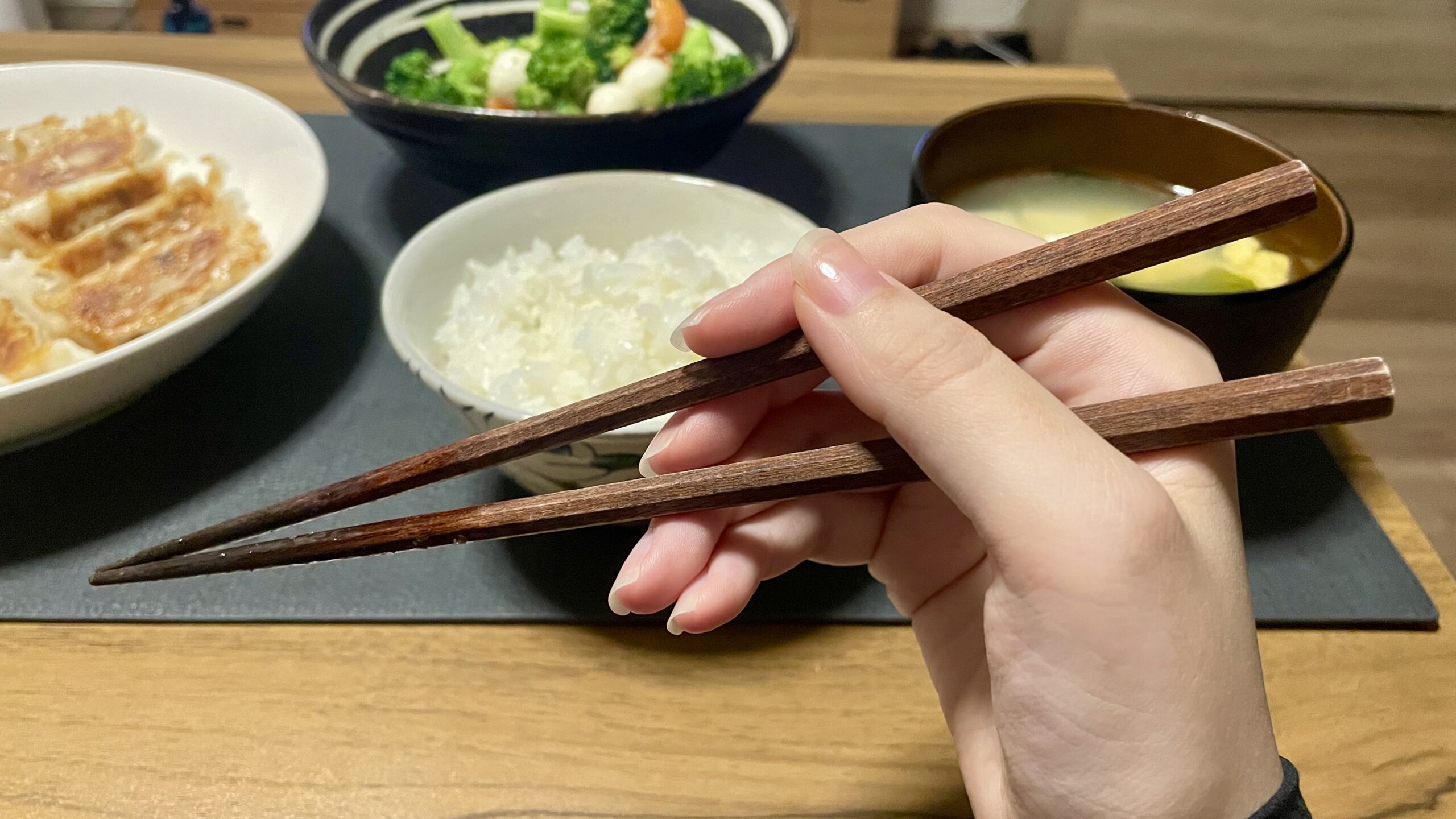
If you spend any time in Japan, you’ll notice chopsticks everywhere: in restaurants, at home, and even tucked into a convenience store bento. It’s easy to assume this comes down to tradition alone, and to wonder why Japanese people rely on chopsticks so much.
But for most Japanese people, chopsticks aren’t really a “cultural symbol” we consciously think about. We learn how to use them as children, use them regularly at mealtimes, and by adulthood, we barely notice we’re using them at all.
That said, chopsticks aren’t used for everything. Curry usually calls for a spoon, pasta for a fork, and steak for a knife and fork, depending on the dish in front of you.
In other words, chopsticks are common in Japan not simply because they’re “traditional,” but because they fit naturally into everyday meals, household habits, and the kinds of food many of us grew up eating.
1. Chopsticks Are Part of Everyday Life in Japan
To someone visiting from abroad, chopsticks might look like a distinctly “Japanese” cultural item. For many Japanese people, though, the feeling is a little different.
At home, it’s common for chopsticks to be set out at mealtimes without much thought. Rice, fish, tofu, vegetables, and simmered dishes are all foods that are easy to eat with chopsticks, and many Japanese meals include exactly that kind of food.
Restaurants often bring them out alongside your dish, and if you pick up a bento or a side dish at a convenience store, you’ll usually find a set of chopsticks included.
Because of this, chopsticks tend to feel less like a symbol of Japanese culture and more like an ordinary tool that shows up at many meals.
That doesn’t mean everything is eaten with chopsticks, though. Curry rice is usually eaten with a spoon, and many people reach for a fork with pasta. Western-style dishes like steak are commonly eaten with a knife and fork, too.
Which utensil to use tends to be an automatic decision based on the dish, rather than a conscious cultural choice.
2. Japanese Children Learn to Use Chopsticks from a Young Age
One reason chopsticks feel so natural in Japan is that many children get plenty of practice with them from a young age.
Of course, no one starts out being good at it. Holding two thin sticks and coordinating them well enough to pick up food is trickier than it looks, especially for small hands.
It’s common for kids to grip chopsticks more like a fist at first, struggle to move the two sticks independently, or simply drop their food.
Depending on the family, children may pick up chopstick use and table manners at home, through school lunches, or through food education programs. One common tip for holding chopsticks is to position them somewhat like you would hold a pencil.
In my experience, I learned from my parents first, and later at school as well. I definitely couldn’t use chopsticks well in the beginning, so I had to practice like anyone else.
Over time, that practice turns into something automatic. And it’s not just about the mechanics of picking up food. Manners around how to hold and use chopsticks, and what not to do with them, can also be part of the learning process.
For people who’ve used chopsticks for years, there’s no real “figuring it out” involved anymore. It just becomes second nature.
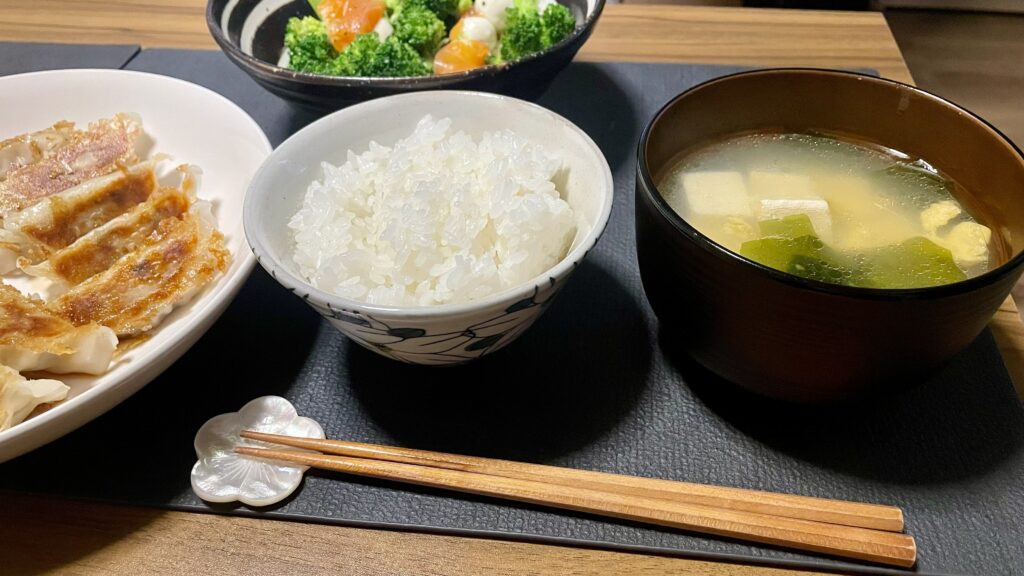
3. Why Chopsticks Work So Well With Japanese Food
Chopsticks are widely used in Japan partly because they suit the kind of food that’s common here. That’s not the only reason, though. Household habits, childhood learning, tableware styles, and a long-standing food culture all play a role too.
Many Japanese meals include dishes like rice, fish, tofu, vegetables, and simmered foods that are genuinely easy to eat with chopsticks.
Meals are also often served as several small side dishes rather than one large plate, and chopsticks work well for eating a little bit from several dishes at once.
Grilled fish is a good example. Chopsticks make it easy to pull the flesh away from the bones bit by bit. Soft foods like tofu can also be picked up in small pieces.
Noodles are another classic case. Soba and udon are generally eaten with chopsticks, and with ramen, it’s common to eat the noodles with chopsticks while using a spoon for the broth.
Japanese tableware and chopsticks have also developed alongside Japanese food culture. The Japanese Government Public Relations Office explains the relationship between Japanese cuisine and its tableware.
I actually find chopsticks easier for salad, too.
One dish where I personally notice how convenient chopsticks can be is a leafy salad.
I find it harder to spear lettuce neatly with a fork, but chopsticks let me gather a bit of it together instead.
Since I grew up using chopsticks, eating salad with them doesn’t feel unusual to me at all. It’s these small, practical details that you only really notice once chopsticks are part of your everyday routine.
Miso soup works a little differently.
Miso soup is usually drunk straight from the bowl rather than eaten with a spoon, while solid ingredients like tofu or seaweed are picked out with chopsticks.
So within a single bowl of soup, you end up using two different approaches.
The Ministry of Agriculture, Forestry and Fisheries of Japan also explains how chopsticks are used in traditional Japanese meals.
Is sushi eaten by hand or with chopsticks?
This is one area where visitors sometimes have the wrong idea.
It’s true that eating nigiri sushi with your hands is a completely accepted way to eat it in Japan.
But eating sushi with chopsticks is just as normal.
Some people use their hands, others use chopsticks, and the general feel of a restaurant can influence which one feels more natural in the moment.
There’s no strict rule that sushi must be eaten one way or the other.
4. Japanese Chopstick Manners You Should Know
There are a handful of chopstick habits that are generally considered poor manners in Japan.
To an outsider, it might sound like a lot of rules, but these aren’t things most people consciously memorize as adults. They’re small habits absorbed gradually, usually starting in childhood.
I learned the basics of chopstick manners early on myself, through everyday life at home and at school.
Here are some of the more well-known ones:
- Standing chopsticks upright in a bowl of rice — This is generally avoided because it resembles how rice is offered to the deceased.
- Passing food directly from one pair of chopsticks to another — This is also avoided, since it echoes a gesture used at funerals.
- Stabbing food with chopsticks instead of picking it up — This is generally seen as bad form.
- Pointing at someone with chopsticks while talking — This is considered impolite.
- Playing with chopsticks or waving them around — This is something children in particular are often told not to do.
- Holding chopsticks in your mouth — This is best avoided as well.
- Dragging a dish closer using chopsticks instead of picking it up with your hands — This, too, is generally frowned upon.
None of this is something people are actively thinking about at every meal. It’s more that these habits get pointed out in childhood, and repetition over the years makes them second nature.
For more details on Japanese chopstick manners, see the Ministry of Agriculture, Forestry and Fisheries of Japan.
5. Chopsticks in Japanese Family Life
One interesting thing about chopsticks in Japan is that habits can vary quite a bit from household to household.
In some families, everyone shares the same set of chopsticks. In others, each person has their own personal pair.
In my family, everyone has their own chopsticks.
Some households even use different designs or colors for each family member, or different lengths for adults and children.
This isn’t something that applies to every Japanese home, though. It really depends on the family.
I personally use wooden chopsticks.
In Japan, chopsticks come in a range of materials and styles, including wood, bamboo, and lacquered finishes.
Since they’re something people use every day, some people choose them based on personal preference, the way you might choose any other everyday item.
Do people use chopstick rests every time?
Chopstick rests are another familiar part of a Japanese table setting.
You’ll often see them at traditional restaurants or at a nicely set table, but at home, they’re not necessarily used every single time.
I’d honestly like to use mine more often, but taking it out feels like a small hassle, so I often skip it.
I think little details like this say a lot about what everyday life in Japan actually looks like.
It’s easy to imagine a perfectly arranged tatami room and beautifully plated food, but daily life at home tends to be a lot more relaxed and ordinary than that.
Some days the chopstick rest comes out, and some days it doesn’t. That’s just how it goes.
Disposable chopsticks are part of daily life too.
Disposable wooden or bamboo chopsticks are common in Japan as well, showing up at restaurants, with convenience store bentos, and with takeout food.
It’s common to use your own chopsticks at home and disposable ones when you’re out.
6. Japanese Chopsticks Can Also Be Great Souvenirs
For Japanese people, chopsticks are simply something used every day. But for visitors, they can also make a distinctly Japanese souvenir.
Chopsticks in Japan range from simple wooden pairs to more elaborate ones made using traditional craft techniques.
Common options include:
- Wooden chopsticks
- Bamboo chopsticks
- Lacquered chopsticks
- Chopsticks with Japanese-style patterns
- Sets that include a matching chopstick rest
- Chopsticks that can be personalized with a name
- Chopsticks made by skilled craftspeople
Because they’re small, lightweight, and genuinely useful, chopsticks can be a practical and distinctly Japanese souvenir from a trip to Japan.
Bringing back gifts for family, friends, and coworkers is a common practice among Japanese travelers as well, which is part of why chopsticks can work so well in this role.
They combine a distinctly Japanese look with everyday usefulness.
You can read more about this gift-giving custom in Why Do Japanese People Buy Souvenirs for Everyone? Understanding Omiyage Culture.
Unlike a purely decorative souvenir, chopsticks are something you can keep using long after your trip ends.
To someone visiting from abroad, chopsticks might look like a symbol of Japanese culture. But for those of us who grew up here, they feel a lot more ordinary than that.
In my case, I learned to hold chopsticks from my parents and practiced at home and at school. I dropped plenty of food before it started to feel natural.
Once that happens, chopsticks turn out to be genuinely useful for a lot of Japanese food — rice, fish, tofu, noodles, vegetables, small side dishes, and yes, even leafy salad, at least in my case.
At the same time, a spoon still wins for curry, and a fork for pasta, depending on what’s on the plate.
The manners around chopsticks aren’t some special body of knowledge either. I picked them up gradually, through family and school, until they stopped requiring any thought at all.
To a visitor, chopsticks might read as something distinctly “Japanese.” To those of us who use them every day, they’re just part of an ordinary meal.
Looking closely at that gap is, in a way, a small window into what everyday life in Japan actually looks like.