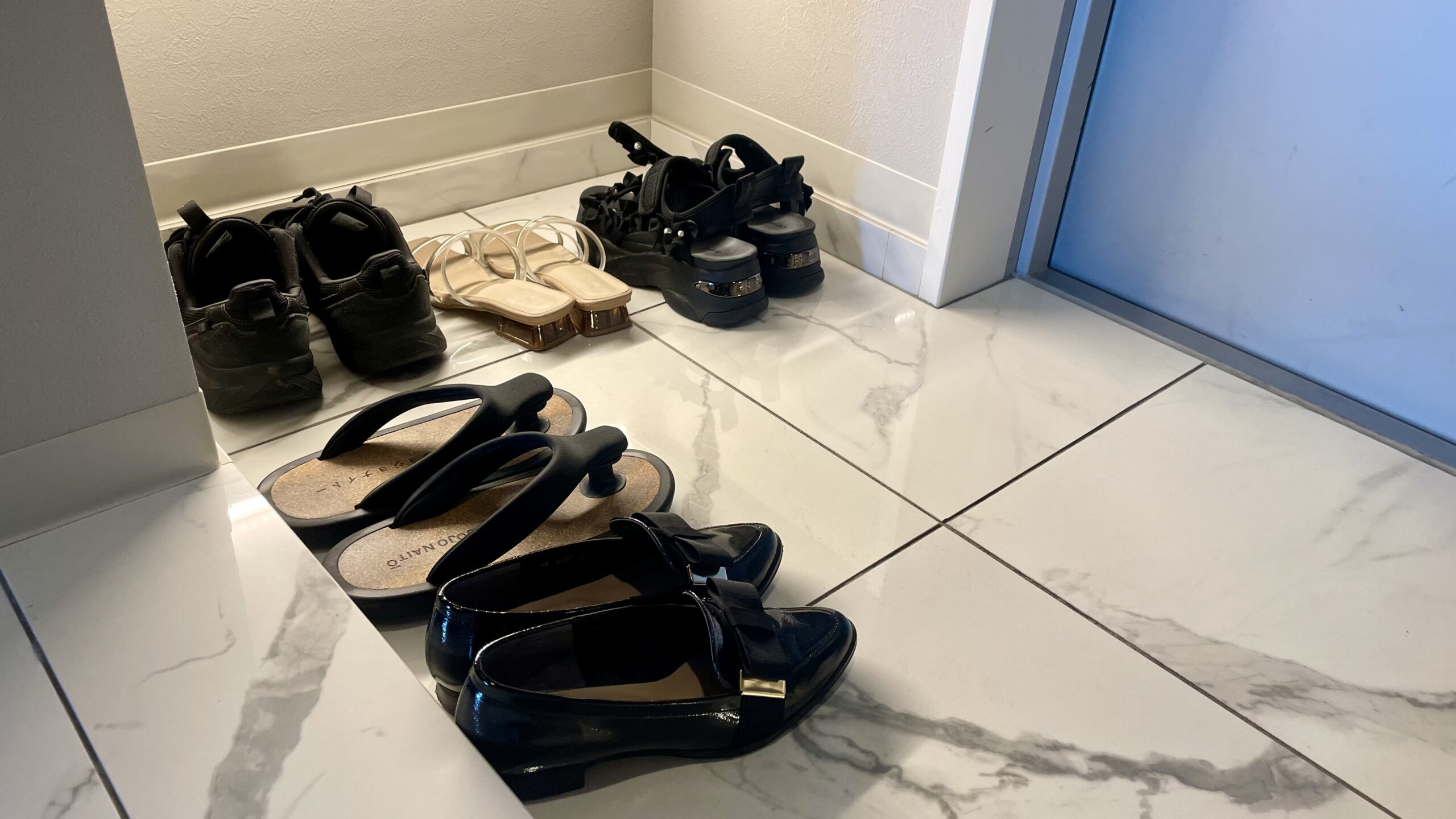
One of the things that surprises many visitors to Japan is how naturally Japanese people take off their shoes indoors.
Walk into someone’s home in Japan, and you’ll almost always stop at the entrance to remove your shoes first. The same goes for many ryokan (traditional inns), some restaurants with tatami seating, and certain temples and historic buildings.
For Japanese people, this is so ordinary that most of us never really stop to think about it. So why do Japanese people take off their shoes in the first place?
“To keep the floor clean” is the simplest answer. But it’s not the whole story.
The way Japanese homes are built, the long history of living close to the floor, the unique space known as the genkan, and a deep-rooted sense of separating “outside” from “inside” — all of these are woven into this one small habit.
What I find especially interesting is that even as lifestyles in Japan have changed a lot, the custom of taking off shoes indoors hasn’t gone anywhere. In this article, I want to walk you through why Japanese people take off their shoes, and also share how it actually feels from a Japanese perspective.
Why Do Japanese People Take Off Their Shoes?
The most obvious reason is simple: to keep the inside of the home clean.
Shoes that have been outside pick up dirt, dust, sand, and moisture. On a rainy day, the soles might even be wet. Bringing that straight into the house means bringing all of that outside grime in with you.
So over time, taking off your shoes before entering a home became a natural part of daily life in Japan.
But to really understand Japan’s shoe-off culture, there’s another important piece of the puzzle.
It’s that Japanese homes have traditionally used the floor itself as living space.
In homes with tatami mats, people would sit on cushions placed directly on the floor and lay out futon on the floor to sleep.
In that kind of lifestyle, the floor isn’t just something you walk across. It’s somewhere you sit, sleep, and relax.
Naturally, bringing outdoor shoes into a space like that never really made sense.
Tatami, in particular, plays an important role in understanding Japan’s shoe-off culture.
In older Japanese homes, tatami rooms were often at the center of daily life. People sat there, ate meals there, and slept there.
Stepping onto that kind of space in outdoor shoes simply wasn’t part of the picture.
That said, life in Japan today looks quite different from the past.
More homes now have Western-style rooms and flooring, and beds have become common in many households.
Plenty of homes don’t have a single tatami room at all.
And compared with previous generations, fewer people sleep on futon laid directly on the floor.
Even so, the habit of taking off outdoor shoes before entering a home has stayed very much alive for many Japanese people.
In other words, you can’t fully explain why people in Japan still take off their shoes today simply by saying, “Because of tatami.”
It’s a habit that developed over a long period of time and has been carried into a modern lifestyle that looks quite different from the one that originally shaped it.
This traditional way of using the floor as part of everyday living helps explain why keeping outdoor shoes away from the living space became so important. The Japan Forum explains more about this aspect of Japanese culture.
The Genkan: A Boundary Between Outside and Inside
Another key part of understanding Japanese shoe culture is the genkan.
Many Japanese homes have a distinctive small step at the entrance.
As you come in from outside, there’s a slightly lower area where you take off your shoes, followed by a raised step into the rest of the home.
In other words, the flow is:
Outside → Genkan → Inside the home
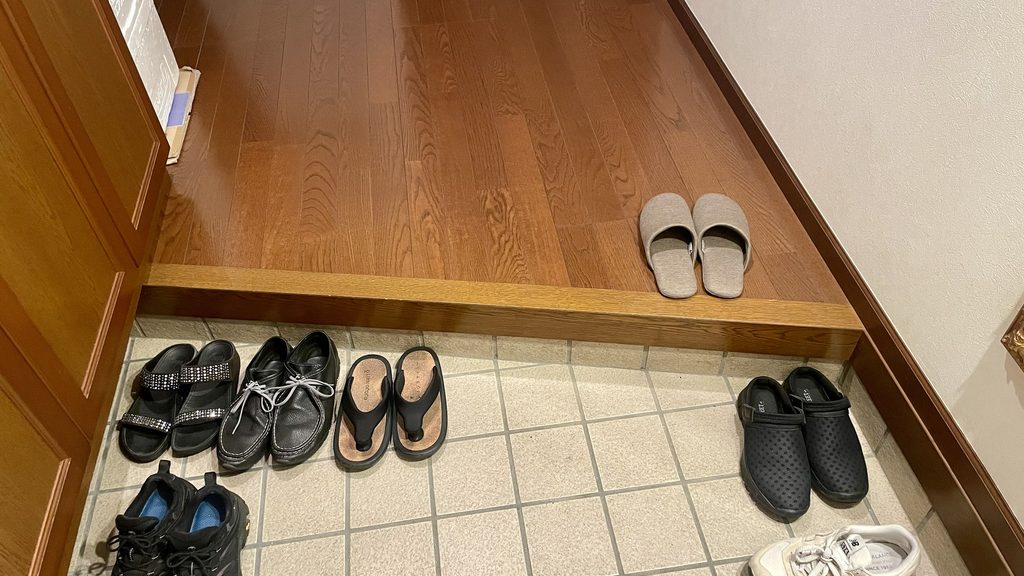
This creates a clear boundary between “outside” and “inside.”
The place for removing your shoes is literally built into the architecture of the house.
The genkan isn’t simply a doorway into the house. It’s a space designed for taking off the shoes you wore outside before stepping into the home itself.
The genkan has a long history in Japanese residential culture and reflects the traditional separation between the outside and the interior of the home. Learn more about the Japanese genkan.
For Japanese people, this movement is so automatic that we rarely think of it as anything special.
But for someone visiting from abroad, that small step and the ritual of removing shoes there can feel like one of the clearest symbols of how Japanese homes are designed differently.
Taking off your shoes at the genkan isn’t only about keeping outdoor dirt from spreading through the house.
You can also think of it as a kind of switch between “outside mode” and “home mode.”
The genkan is where that shift happens — the moment you move from being out in the world to being at home.
Japanese Habits After Taking Off Your Shoes
Once the shoes come off, there are a few more habits that often follow.
Many households have indoor slippers, and some Japanese homes keep a separate pair of guest slippers ready for visitors.
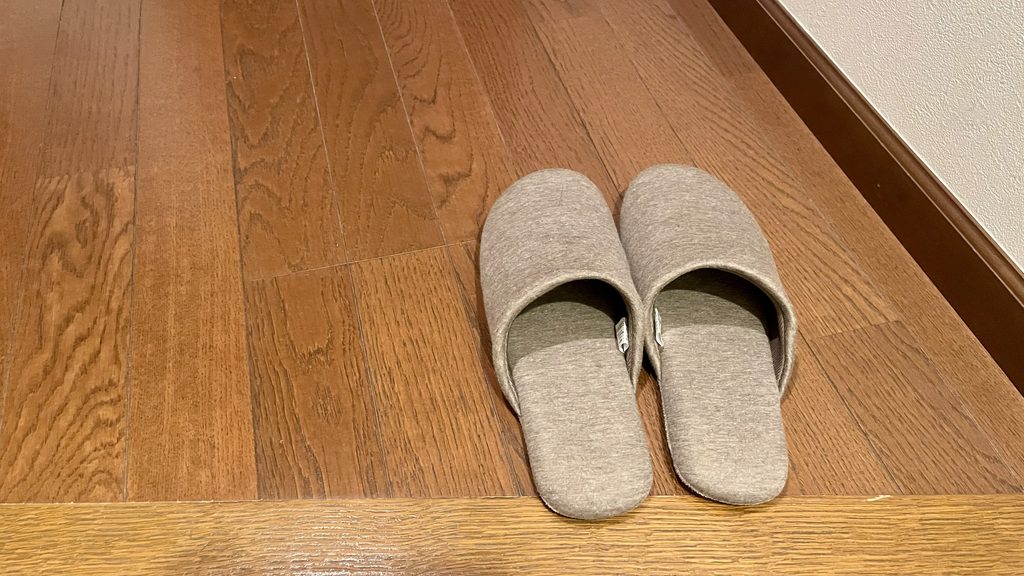
Whenever someone comes to my house, I naturally find myself thinking, “I need to bring out the slippers.”
A guest takes off their shoes at the genkan, and I hand them a pair of indoor slippers. For me, that’s just a completely natural sequence of events.
That said, whether or not someone wears slippers at home varies from person to person.
I wear slippers indoors myself. The main reason is that I don’t like getting dust or small bits of dirt stuck to the soles of my feet when I walk around barefoot.
My husband, on the other hand, doesn’t wear slippers and spends his time at home barefoot.
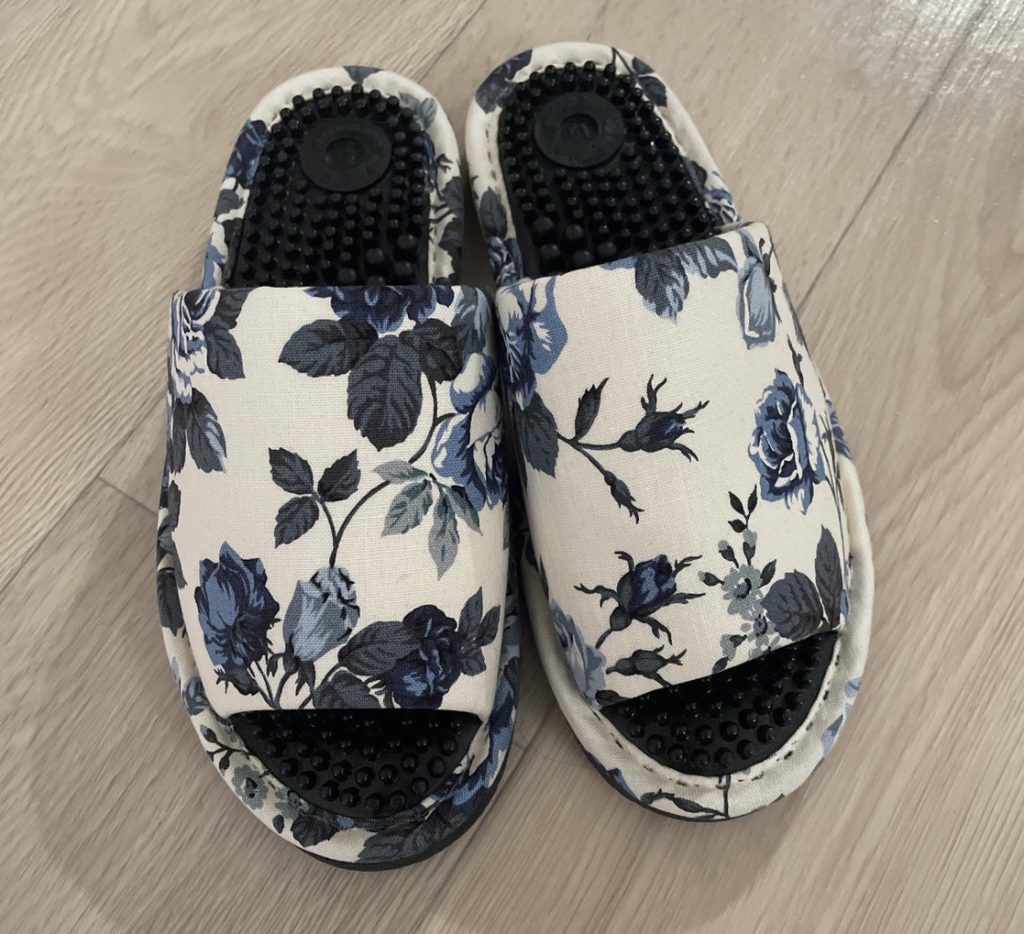
So it’s not accurate to say that “Japanese people wear slippers indoors” as some kind of fixed rule. What happens after the shoes come off depends on the household and the individual.
There’s also another habit when tatami is involved.
It’s common to take off indoor slippers before stepping onto a tatami floor.
Tatami is a surface where people may sit or even lie down directly, so the idea is to keep it free not only from outdoor shoes but also from slippers.
Some households also keep a separate pair of slippers just for the bathroom.
I don’t currently use toilet slippers at home, but I did use them at my parents’ house when I was growing up.
In this way, Japanese households sometimes use different types of footwear for different areas.
There’s also a small custom around how shoes are placed once they’re off.
Many people turn their shoes so the toes face toward the entrance and line them up neatly.
Of course, not everyone does this every single time.
But in Japan, there is sometimes an image that a well-brought-up person is someone who always lines up their shoes neatly after taking them off.
That small action of straightening your shoes has become quietly associated with good manners and good upbringing.
For example, when you visit someone’s home and take off your shoes at the genkan, there’s a difference between someone who simply kicks their shoes off carelessly and someone who naturally straightens them.
Seeing the latter can give you the impression that the person is considerate, well-mannered, and well brought up.
This isn’t a strict rule written down anywhere. It’s simply one of those unspoken manners and cultural expectations that have existed in Japan for a long time.
Do Japanese People Take Off Their Shoes Everywhere?
You might assume that Japanese people always take off their shoes indoors. But that’s not actually the case.
It depends on where you are.
In Japanese homes and at ryokan, shoes generally come off. The same can be true at restaurants with tatami seating, some temples, and historic buildings.
On the other hand, at convenience stores, shopping malls, and most standard hotels, you keep your shoes on just like you would in many other countries.
So even in Japan, “always take your shoes off indoors” isn’t a rule that applies everywhere.
In fact, even Japanese people sometimes pause for a moment and wonder, “Wait, do we take our shoes off here?”
This happens especially at restaurants we’re visiting for the first time. You might notice a shoe locker at the entrance or see tatami seating further inside, and that’s when you realize, “Oh, this is a shoes-off restaurant.”
I still sometimes hesitate for a moment like this when I visit restaurants.
When I’m not sure, I check the signs or simply look at what the people around me are doing.
If you’re visiting Japan and aren’t sure whether you should take off your shoes, there’s no need to overthink it. Checking the signs or seeing whether other people have taken off their shoes will usually make it clear.
Learning to Take Off Shoes from Childhood
Part of why this habit feels so natural to Japanese people is that we experience it repeatedly from a young age.
And it doesn’t only happen at home.
Many Japanese schools also separate outdoor shoes from indoor footwear.
At many Japanese schools, students take off their outdoor shoes when they arrive and change into indoor shoes called uwabaki.
When they leave school, they change back into their outdoor shoes.
However, some schools have recently started moving away from this system and allowing students to stay in their outdoor shoes throughout the school. Japanese school customs are also gradually changing.
I remember changing into uwabaki myself when I was in elementary school.
Because of this, the idea that “shoes worn outside” and “shoes worn indoors” are separate things becomes familiar to Japanese children from a fairly young age.
I still remember being genuinely surprised as an elementary school student when I first learned that in some countries, it’s normal to spend time at home wearing shoes.
“Wait, people wear shoes inside their homes?”
At the time, it was almost impossible for me to imagine.
Looking back, I think that reaction shows how deeply the idea of “taking off your shoes at home” was already established in my mind as simply the normal way of life.
Growing up in Japan means experiencing this pattern again and again:
- You take off your shoes at home.
- You change into uwabaki at school.
- You take off your shoes at the entrance of a ryokan.
- You take off your slippers when you step onto tatami.
These small everyday customs are part of what makes Japanese culture interesting to discover. You can also read about Japanese omiyage culture and why bringing gifts home is such a common part of life in Japan.
So when adults are asked, “Why do you take off your shoes?”, many people might initially answer, “Because that’s just normal.”
The habits we have considered normal since childhood are often the hardest ones to explain.
Why Taking Off Shoes Feels Like Coming Home
Here, I want to share something a little more personal.
For me, as a Japanese person, taking off my shoes isn’t simply a rule for keeping the house clean.
When I come home after being out and take off my shoes at the genkan, I feel, “Ah, I’m home.”
After finishing work or running errands, coming home, taking off my shoes, and stepping inside helps me relax a little.
Removing the shoes I wore outside feels like a shift from “me out in the world” to “me at home.”
Of course, I don’t think every Japanese person feels exactly the same way. But for me, the physical act of taking off my shoes is strongly connected to the feeling of coming home.
And I think this feeling may have remained even as Japanese lifestyles have changed.
In the past, it was common to sit on tatami and sleep on futon laid out on the floor. Today, homes with Western-style flooring are more common, and many people sleep in beds. More homes also have no tatami at all.
Even so, the custom of taking off shoes at the genkan hasn’t disappeared.
Maybe this isn’t simply because an old rule has survived out of habit. Perhaps taking off your shoes is still connected to the feeling of returning from the outside world to your own home.
For Japanese people, taking off our shoes at the genkan is such a small, everyday action that we barely notice it.
But inside that small action are the way Japanese homes are designed, a sense of cleanliness, quiet manners, and a Japanese sense of what “home” means.
There isn’t a single sentence that can fully explain why Japanese people take off their shoes indoors. Saying “Japanese people just like things clean” isn’t enough.
This attention to cleanliness can also be seen in other everyday Japanese habits, such as taking trash home when there is no convenient place to throw it away. Read more about why Japanese people take their trash home.
Several things come together:
- Keeping outdoor dirt from coming inside
- A long history of living close to the floor
- The role of tatami in traditional Japanese homes
- The clear boundary between “outside” and “inside” created by the genkan
All of these things are connected to one simple everyday habit.
And in modern Japan, even as homes and lifestyles continue to change, the habit of taking off shoes remains.
For me, taking off my shoes at the genkan is still the moment when I feel that I’ve truly come home.
For Japanese people, it’s such an ordinary thing. But to someone from another country, this small habit may contain a surprising amount of everyday Japanese life.
The next time you visit Japan and find yourself taking off your shoes at someone’s home or a ryokan, take a moment to notice that small action.
It might give you a slightly deeper sense of what everyday life in Japan actually feels like.