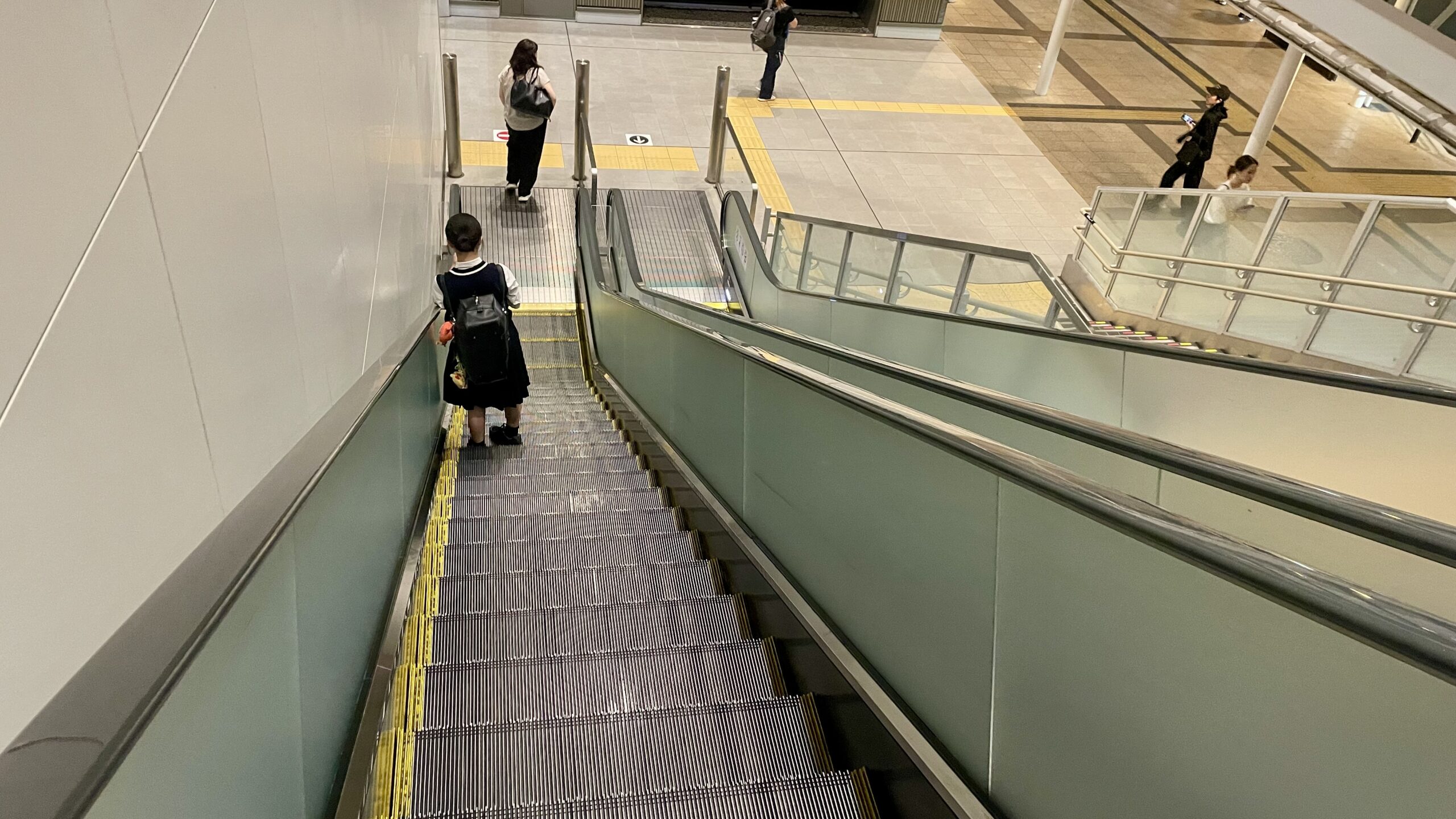
You step onto an escalator in Osaka, and everyone is standing on the right, with the left side wide open. A week later, you’re in Tokyo, and it’s the opposite.
If you’ve spent time in more than one Japanese city, you may have noticed this and wondered whether it’s an actual rule.
It isn’t, not exactly.
Standing on one side is a habit, not a national law, and even that habit isn’t as fixed as it may seem. In fact, transportation operators across Japan are continuing to ask people to stop walking on escalators altogether.
So, while visitors often ask, “Which side should I stand on?”, there’s a more interesting question: Is the traditional left-or-right habit still as important as it used to be?
Which Side Do People Stand On in Japan?
Tokyo and Eastern Japan — Stand on the Left
In Tokyo and much of eastern Japan, people traditionally stand on the left side of the escalator, leaving the right side open for anyone who wants to walk.
You’ll see this in train stations, department stores, and shopping malls across the Kanto region.
Most visitors can figure it out quickly just by watching the people around them.
Osaka and Some Other Western Areas — Stand on the Right
Head to Osaka, and the convention is generally reversed.
People traditionally stand on the right side, leaving the left side open.
This pattern is also common in parts of the Kansai region, although it isn’t perfectly consistent everywhere. In some buildings and stations, especially when it’s not crowded, people may not follow the pattern closely.
There Isn’t One Nationwide Rule
Here’s the part that surprises many visitors:
There is no nationwide Japanese law that says you must stand on a particular side of an escalator.
The left-side and right-side patterns are social conventions that developed through local habits and became familiar to people over time.
That means you shouldn’t think of them as strict rules that every Japanese person follows.
In busy places, people may naturally form a line on one side. When an escalator isn’t crowded, however, you may also see people standing next to each other.
So if you’re visiting Japan, you don’t need to memorize a national “escalator rule.”
Why Do Tokyo and Osaka Have Different Habits?
The exact reason isn’t completely clear.
One commonly repeated explanation connects Osaka’s right-side convention with the 1970 Osaka Expo. According to this theory, station staff encouraged people to keep one side open so that large crowds could move more efficiently.
It’s an interesting explanation, but it should be treated as a commonly repeated theory rather than a confirmed historical fact.
What we do know is that different regions developed different habits, and those habits became established through everyday use.
This is a good example of why Japanese customs aren’t always as uniform as they may appear from the outside.
What Is Happening With Escalator Etiquette in Japan in 2026?
There’s another important part of the story today.
From July 21 to August 31, 2026, transportation operators and organizations across Japan are running a coordinated safety campaign asking passengers to stop walking on escalators.
The 2026 campaign involves 58 railway and transit operators and 7 industry organizations, with support from the Ministry of Land, Infrastructure, Transport and Tourism and the Consumer Affairs Agency.
The campaign encourages people to:
Stand still and hold the handrail.
The reason is simple: walking or running on an escalator can cause someone to lose their balance and collide with other passengers. If people are standing on both sides, they can also have better access to handrails and reduce the risk of falling.
The campaign is not a brand-new rule introduced in 2026.
Similar safety campaigns have been carried out before. For example, a campaign in 2024 involved 57 railway operators and 5 organizations.
So it’s more accurate to think of this as an ongoing safety awareness effort, rather than a new nationwide law.
JR East’s 2026 campaign announcement
Is Walking on an Escalator Illegal in Japan?
No, not nationwide.
Japan does not have a national law that generally prohibits people from walking on escalators.
However, some local governments have introduced their own rules encouraging or requiring people to stand still.
For example, Saitama Prefecture introduced an ordinance in 2021, and Nagoya introduced a similar ordinance in 2023.
These local rules do not mean that the entire country has adopted the same legal requirement.
This distinction is important because visitors sometimes see a campaign or local rule and assume it applies everywhere in Japan.
It doesn’t.
Japan doesn’t have one nationwide escalator rule.
Does Everyone Actually Stand Still?
This is where official safety campaigns and everyday life can look a little different.
I live in Hiroshima, and when I use an escalator, I usually stand on the left.
But when I’m riding with someone I know, such as my husband or a friend, and the escalator isn’t crowded, we sometimes stand side by side instead of automatically leaving one side open.
I normally stand still rather than walk, although I don’t really think about “the rule” when I do it. It’s just what I’ve become used to doing.
If someone comes up behind us and needs to get through, we simply move aside and let the person pass.
Recently, I’ve noticed more posters and announcements encouraging people to stand still instead of walking, and I think that’s a good thing because standing still is safer.
At the same time, I don’t think it’s always necessary to leave one entire side empty.
When there are a lot of people, I sometimes think it’s a little strange when everyone insists on forming a single line on one side. If people stand in two lines, the queue can be shorter and the escalator can be used more efficiently.
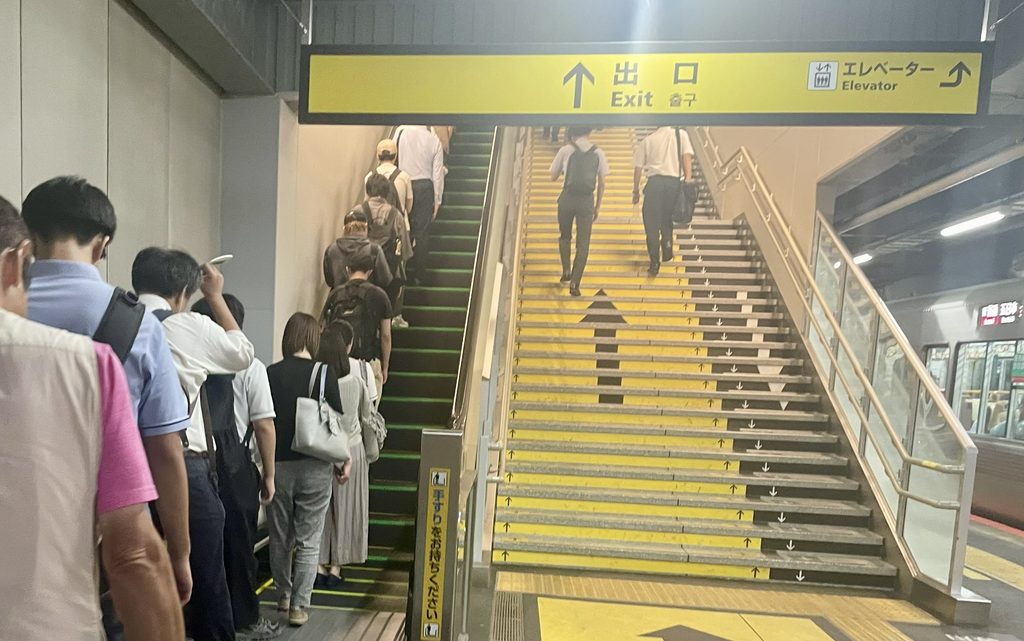
I don’t particularly blame people who walk, either. Some people are genuinely in a hurry, and I understand that.
For me, it’s more about being flexible and considerate than strictly following an unwritten rule.
And that’s probably the most realistic way to look at escalator etiquette in Japan.
The official message is becoming clearer: standing still is safer.
But the traditional habit of leaving one side open is still common, and people’s behavior doesn’t change overnight just because a poster tells them to.
Both things can be true at the same time.
What Should Visitors Do?
If you’re visiting Japan, you really don’t need to worry too much about getting the “correct” side.
Here are a few simple tips.
1. Look at what people around you are doing
When you’re unsure, simply watch the people ahead of you.
Local habits can vary by region, station, building, and situation, so following the people around you is usually the easiest approach.
2. Stand still when you can
Standing still is the safer option and is consistent with the current safety campaigns across Japan.
If you’re not in a hurry, there’s usually no reason to walk.
3. Be considerate if someone needs to pass
If someone is clearly in a hurry and there is room to let them through safely, you can move aside.
You don’t need to feel that you are breaking an important Japanese rule if you don’t stand perfectly on the expected side.
4. Don’t worry if you’re on the “wrong” side
If you accidentally stand on the opposite side from everyone else, don’t panic.
People generally aren’t going to make a big scene about it.
Just pay attention to what’s happening around you and adjust if necessary.
5. Put safety before etiquette
Most importantly, hold the handrail and stay safe.
Which side you stand on matters less than avoiding falls and collisions.
What This Says About Japanese “Rules”
A lot of things visitors describe as “Japanese rules” are actually something more flexible.
They may be local customs, regional habits, or social expectations that change depending on the situation.
Escalator etiquette is a perfect example.
The left-side and right-side habits are real, but they aren’t universal. They vary by region, aren’t always followed consistently, and are being challenged by ongoing safety campaigns.
Japan doesn’t have one uniform behavioral rulebook that everyone follows in exactly the same way.
Customs can vary by region, generation, and situation.
And they can change over time, too.
For another example of how unspoken expectations work in shared public spaces, check out why Japanese trains are so quiet.
Conclusion
If you take one thing away from this article, let it be this:
You don’t need to stress about getting Japan’s “escalator rule” exactly right.
Look at what people around you are doing, stand still when you can, and be considerate if someone needs to get by.
Tokyo may traditionally favor the left while Osaka favors the right, but there has never been one simple nationwide rule.
And as Japan continues to encourage people to stand still for safety, even these familiar customs may continue to evolve.
More than anything, escalator etiquette is a reminder that Japanese customs are often more regional, more flexible, and more human than they first appear.